
November 18, 2026
Mortgage News
Budget 2026: 5 Changes for First-Time Buyers and Homeowners
The 5 Budget 2026 changes that matter for buyers and homeowners, from the new Your First Home scheme to the First Time Buyer ISA, in plain English.
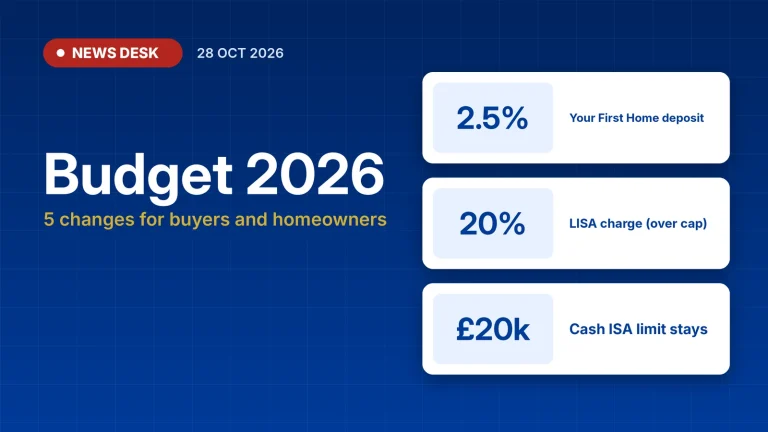
Budget 2026 for first-time buyers and homeowners brings one big new scheme and several smaller changes. The Chancellor confirmed the Your First Home scheme for new-build homes in England, announced a First Time Buyer ISA to replace the Lifetime ISA, and cut one Lifetime ISA charge from 29 October. There was no change to Stamp Duty rates.
Here are the 5 changes that matter most for your mortgage and home-buying plans, taken from the official Budget documents published on GOV.UK on 28 October 2026.
Key points
- Your First Home: a 20% government equity loan on new-build homes in England, with a deposit from 2.5%.
- A new First Time Buyer ISA will replace the Lifetime ISA for new savers from April 2029.
- From 29 October 2026, the Lifetime ISA charge for homes over £450,000 falls from 25% to 20%.
- The cash ISA limit stays at £20,000 for all adult savers.
- No changes to Stamp Duty rates or first-time buyer relief were announced.
2.5%minimum deposit with Your First Home
20%new Lifetime ISA charge for homes above the £450,000 cap
£20,000cash ISA limit, now staying for all adult savers
1. Your First Home scheme confirmed
The government has confirmed £4.7 billion over five years for Your First Home, a new equity loan scheme to help first-time buyers buy a new-build home in England. Here’s how it’s set to work:
- Deposit: at least 2.5% of the price.
- Equity loan: the government lends 20% of the price.
- Mortgage: a repayment mortgage from a participating lender covers the rest.
- Who can apply: first-time buyers with a household income of £110,000 or less, or £140,000 or less in London, buying a home to live in, within a local price cap.
Illustrative example
A £300,000 new-build home:
Deposit 2.5% = £7,500 · Equity loan 20% = £60,000 · Mortgage = £300,000 − £7,500 − £60,000 = £232,500
The price must be within the local cap for the area. Caps vary across England.
The equity loan is interest-free for the first 5 years. Interest of 1.5% applies in year 6, and 3% from year 7. This interest is paid separately and doesn’t reduce what you owe on the loan.
Good to understand before you apply
You normally repay the loan when you sell, and you repay 20% of the home’s value at that time, not the amount you borrowed. So if your home goes up in value, you repay more; if it goes down, you repay less. Full rules on fees, valuations and remortgaging will be published before the scheme opens.
Timeline: the government says pre-registration and guidance will be available by the end of December 2026, the first applications in February 2027, and the first sales from April 2027. No lenders or developers have been named yet.
2. A First Time Buyer ISA will replace the Lifetime ISA
The government confirmed that a new First Time Buyer ISA will replace the Lifetime ISA for new savers, with the product due to launch in April 2029. According to the Budget tax documents, it will pay a 25% government bonus on the final account balance, up to a maximum of £20,000, when you withdraw it to buy a first home worth up to £450,000.
If you already have a Lifetime ISA, the government says you’ll be able to keep paying in and using it under the current rules. More details, including who can open one and how much you can pay in each year, are still to come before launch.
3. Lower Lifetime ISA charge for homes above £450,000
At the moment, you can only use a Lifetime ISA bonus towards a first home costing £450,000 or less. If you take the money out to buy a more expensive home, you pay a 25% withdrawal charge.
From 29 October 2026, that charge falls to 20% for buying a home above the £450,000 cap. The 25% charge stays in place for other withdrawals that aren’t allowed under the rules.
4. Cash ISA limit stays at £20,000
A planned cut to the cash ISA allowance has been reversed. The cash ISA limit will stay at £20,000 for all savers over 18 from April 2027. This may be useful if you’re saving a deposit in cash.
5. No change to Stamp Duty rates
The Budget documents don’t set out any change to Stamp Duty Land Tax rates, bands or first-time buyer relief. In England and Northern Ireland, first-time buyers still pay no Stamp Duty on homes up to £300,000, and 5% on the portion from £300,001 to £500,000, as shown on GOV.UK’s Stamp Duty rates page.
Also announced
Landlords: from 6 April 2027, Income Tax on property income will rise, with a property basic rate of 24% and a property higher rate of 44% in England, Wales and Northern Ireland.
Higher-value homes: a new council tax surcharge on homes worth £2 million or more takes effect from April 2028.
What this means for you
If you’re saving for your first home, the biggest news is Your First Home, though it’s for new-build homes in England only and won’t open for applications until February 2027. If you already have a Lifetime ISA, nothing changes for you now, apart from the lower charge if you buy above £450,000.
Our guide to how much deposit you need to buy a home explains deposits, loan-to-value and the other costs to plan for. We’ll update this page and our guides as more details are published.
%Loan-to-value calculatorSee what different deposits mean for your loan-to-valueTry it →
Sources
- GOV.UK – Your First Home (28 October 2026)
- GOV.UK – Budget 2026: Overview of tax legislation and rates (28 October 2026)
- GOV.UK – Budget 2026: Breathing space for today, hope for the future (28 October 2026)
- GOV.UK – Stamp Duty Land Tax: Residential property rates
Published 28 October 2026. This bulletin reflects the Budget documents published on that date. It’s general educational information only and is not regulated financial advice.
Free reminder service
Is your fixed rate ending soon?
When a deal ends, most mortgages move onto the lender's standard variable rate, which is usually higher. We'll remind you in good time to look at your options.
- 1Tell us when your deal endsJust your first name, email, and the month and year
- 2We email you 6, 3 and 1 month beforeSo you have time to compare, without the rush
- 3Look at your options, no pressureOur guides and calculators are always free
Set up your free reminder
Takes under a minute. Unsubscribe any time.
Your reminder is set
We've sent a confirmation email. If it's not there in a few minutes, check your spam folder.
Mortgage Owl provides general educational information only, not regulated financial advice.
About the author: Steve

Steve is the founder of Mortgage Owl and is training to become a mortgage adviser. He’s currently studying Module 1 of 3 of CeMAP, the Certificate in Mortgage Advice and Practice.
He originally studied business, finance and accountancy, then spent 30 years in policing and the merchant navy before returning to his first passion: helping people make sense of money.
He writes every Mortgage Owl guide in plain English, so you can feel informed before you speak to an adviser.
Qualifications: Registered student with the London Institute of Banking & Finance (LIBF), studying for CeMAP.
He originally studied business, finance and accountancy, then spent 30 years in policing and the merchant navy before returning to his first passion: helping people make sense of money.
He writes every Mortgage Owl guide in plain English, so you can feel informed before you speak to an adviser.
Qualifications: Registered student with the London Institute of Banking & Finance (LIBF), studying for CeMAP.
Related guides
November 9, 2026
November 1, 2026