
November 1, 2026
Mortgage News
Bank Rate Rises to 4%: What It Means for Your Mortgage
The Bank of England raised Bank Rate from 3.75% to 4% on 5 November 2026. Here’s what it could mean for tracker, variable and fixed-rate mortgages.
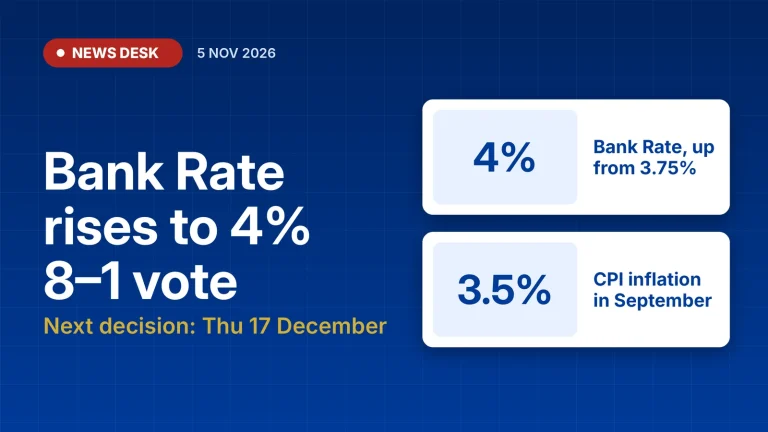
The Bank Rate rise announced on 5 November 2026 takes the Bank of England’s interest rate from 3.75% to 4%. The Monetary Policy Committee voted 8–1 for the 0.25 percentage point increase, and one member voted for a larger rise to 4.25%.
Here’s why the Bank raised rates, what it could mean for your mortgage depending on the type of deal you have, and when the next decision is due.
Key points
- Bank Rate rose from 3.75% to 4% on 5 November 2026, by an 8–1 vote.
- The Bank expects inflation to rise to around 5% by the middle of 2027, as global energy prices keep rising.
- Tracker mortgage payments usually rise soon after a Bank Rate change.
- Fixed-rate payments don’t change until your deal ends.
- The next Bank Rate decision is on Thursday 17 December 2026.
4%Bank Rate from 5 November 2026, up from 3.75%
3.5%CPI inflation in September 2026
17 Decdate of the next Bank Rate decision
1. Why the Bank of England raised rates
The Bank’s job is to keep inflation at the government’s 2% target, and Bank Rate is its main tool for doing that. In its November summary, the Bank says global energy prices have continued to rise from an already high level, with the conflict in the Middle East now in its ninth month.
CPI inflation rose to 3.5% in September, and the Bank now expects it to rise to around 5% by the middle of next year. The Committee voted to raise Bank Rate to lean against that rise in inflation. The Bank also noted that activity data in recent months had generally been stronger than expected.
2. What a Bank Rate rise means for tracker mortgages
A tracker mortgage follows Bank Rate plus a set margin. MoneyHelper explains that if Bank Rate rises by 0.25%, your tracker rate rises by the same amount, so your payment usually goes up soon after.
Illustrative example
£200,000 tracker mortgage over 25 years, at Bank Rate plus 0.75%.
Before the rise: 3.75% + 0.75% = 4.5%, about £1,112 a month.
After the rise: 4% + 0.75% = 4.75%, about £1,140 a month.
Change: about £29 a month more, or about £343 a year
Figures are illustrative. Your own margin, balance and term will differ.
3. Standard variable and discount rates
Your lender sets its own standard variable rate. MoneyHelper says SVRs usually follow Bank Rate changes, but your lender decides whether to pass a change on and by how much. A discount rate is set a fixed amount below the lender’s SVR, so it moves when the SVR moves.
If you’re on one of these rates, your lender should tell you before your payment changes.
4. If you’re on a fixed rate
Your payment won’t change until your fixed deal ends. Bank Rate does matter when it ends, though, because new fixed rates are priced partly on where markets expect Bank Rate to go. Our guide to how mortgage interest rates work explains why.
UK Finance says around 1.8 million fixed-rate mortgages are due to end through 2026. If yours is one of them, lenders that have signed the Mortgage Charter let you lock in a new deal up to six months before your current one ends. Our guide to what happens when your fixed-rate mortgage ends walks through your options.
£New payment calculatorCompare your payment now with what it could be at a new rateTry it →
5. What happens next
The Bank says monetary policy “is not on a pre-set path”. It will look at the latest evidence at each meeting and adjust Bank Rate as needed to bring inflation back to 2% in the medium term. The next decision is announced on Thursday 17 December 2026.
What this means for you
- Check which type of deal you have. Your mortgage offer or annual statement will say whether it’s fixed, tracker, discount or variable.
- Know your deal end date. Our free fixed-rate reminder emails you 6, 3 and 1 month before it ends.
- Take a quick look at the whole picture. Our free mortgage health check asks six questions and gives you a plain-English checklist.
- If a higher payment would be hard to manage, talk to your lender early. The FCA says talking to your lender won’t affect your credit file, and free help is available from MoneyHelper, StepChange and Citizens Advice.
Important
Your home may be repossessed if you do not keep up repayments on your mortgage or any other debt secured on it.
Sources
- Bank of England – Bank Rate increased to 4% – November 2026 Monetary Policy Summary and Minutes
- MoneyHelper – How will interest rates affect my mortgage?
- UK Finance – What global tensions mean for your mortgage
- GOV.UK – Mortgage Charter
- Financial Conduct Authority – Support available for mortgages as interest rates rise
Published 8 November 2026. News bulletins record the facts on the day they’re published. This is general educational information only and is not regulated financial advice.
Free reminder service
Is your fixed rate ending soon?
When a deal ends, most mortgages move onto the lender's standard variable rate, which is usually higher. We'll remind you in good time to look at your options.
- 1Tell us when your deal endsJust your first name, email, and the month and year
- 2We email you 6, 3 and 1 month beforeSo you have time to compare, without the rush
- 3Look at your options, no pressureOur guides and calculators are always free
Set up your free reminder
Takes under a minute. Unsubscribe any time.
Your reminder is set
We've sent a confirmation email. If it's not there in a few minutes, check your spam folder.
Mortgage Owl provides general educational information only, not regulated financial advice.
About the author: Steve

Steve is the founder of Mortgage Owl and is training to become a mortgage adviser. He’s currently studying Module 1 of 3 of CeMAP, the Certificate in Mortgage Advice and Practice.
He originally studied business, finance and accountancy, then spent 30 years in policing and the merchant navy before returning to his first passion: helping people make sense of money.
He writes every Mortgage Owl guide in plain English, so you can feel informed before you speak to an adviser.
Qualifications: Registered student with the London Institute of Banking & Finance (LIBF), studying for CeMAP.
He originally studied business, finance and accountancy, then spent 30 years in policing and the merchant navy before returning to his first passion: helping people make sense of money.
He writes every Mortgage Owl guide in plain English, so you can feel informed before you speak to an adviser.
Qualifications: Registered student with the London Institute of Banking & Finance (LIBF), studying for CeMAP.
Related guides
October 28, 2026

October 23, 2026